 Add to Chrome
 Add to Firefox
 Add to Edge
Reasoning through Verifiable Forecast Actions: Consistency-Grounded RL for Financial LLMs
May 21, 2026
Financial markets are characterized by extreme non-stationarity, low signal-to-noise ratios, and strong dependence on external information such as news, company fundamentals, and macroeconomic signals. Yet, existing approaches either abstract time-series into text or decouple forecasting from language-based reasoning, leading to a fundamental mismatch between qualitative reasoning and quantitative outcomes. To address this, we introduce StockR1, a time-series-enhanced LLM that unifies stock forecasting and financial reasoning through a verifiable forecast action. Based on a tool-call design, the model first emits a forecast action, which is a structured and interpretable representation of its qualitative market outlook. It then invokes a time-series decoder conditioned on this action to generate distributional future trajectories, leading to more informed question answering and financial reasoning. We optimize the full pipeline with reinforcement learning, where rewards jointly reflect answer validity, forecast accuracy, and consistency between generated actions and observed time-series dynamics. In addition, rewards are reweighted by a sample-level uncertainty scalar, encouraging the model to accommodate varying uncertainty in market dynamics. We evaluate StockR1 on financial question answering and stock forecasting over a large-scale 10-year benchmark. Our method consistently outperforms time-series baselines and general-purpose LLMs, improving reasoning accuracy by 17.7% (4B) and 25.9% (8B). These findings demonstrate that structuring the forecast actions establishes a powerful synergy between language reasoning and temporal prediction, enabling LLMs to reason through verifiable, interpretable, and numerically grounded decisions.

Low-Rank Adaptation for Foundation Models: A Comprehensive Review
Dec 31, 2024The rapid advancement of foundation modelslarge-scale neural networks trained on diverse, extensive datasetshas revolutionized artificial intelligence, enabling unprecedented advancements across domains such as natural language processing, computer vision, and scientific discovery. However, the substantial parameter count of these models, often reaching billions or trillions, poses significant challenges in adapting them to specific downstream tasks. Low-Rank Adaptation (LoRA) has emerged as a highly promising approach for mitigating these challenges, offering a parameter-efficient mechanism to fine-tune foundation models with minimal computational overhead. This survey provides the first comprehensive review of LoRA techniques beyond large Language Models to general foundation models, including recent techniques foundations, emerging frontiers and applications of low-rank adaptation across multiple domains. Finally, this survey discusses key challenges and future research directions in theoretical understanding, scalability, and robustness. This survey serves as a valuable resource for researchers and practitioners working with efficient foundation model adaptation.
Hypformer: Exploring Efficient Hyperbolic Transformer Fully in Hyperbolic Space
Jul 01, 2024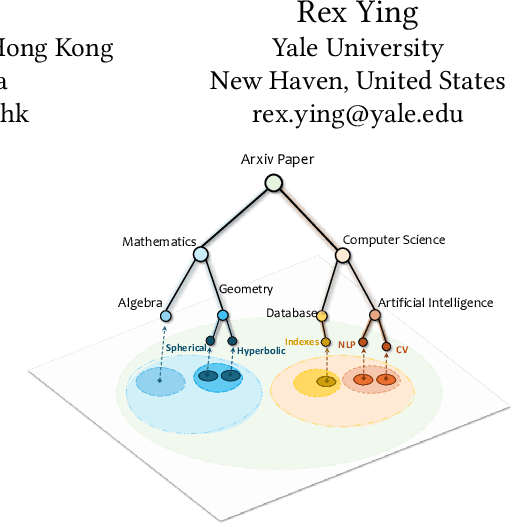
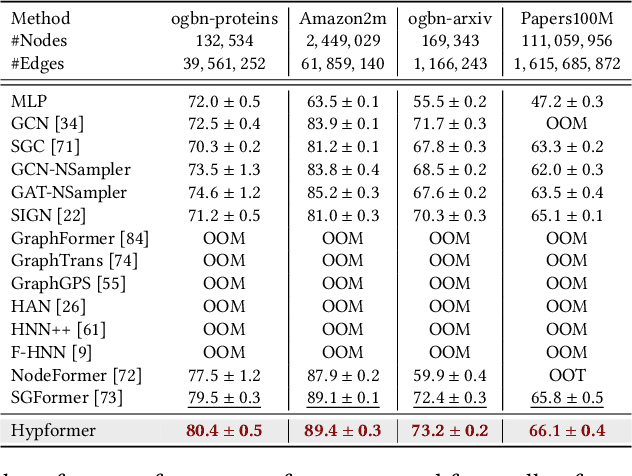

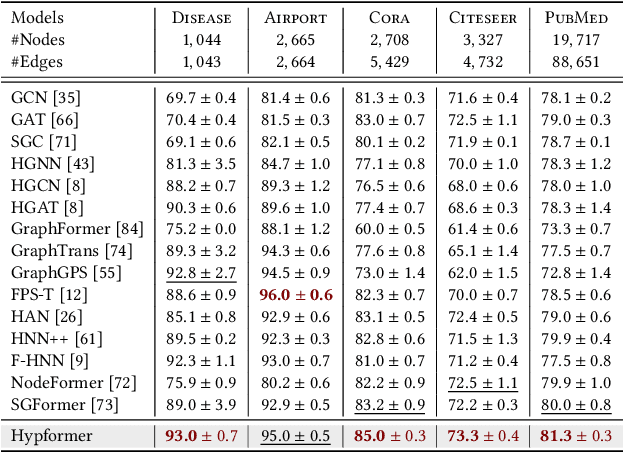
Hyperbolic geometry have shown significant potential in modeling complex structured data, particularly those with underlying tree-like and hierarchical structures. Despite the impressive performance of various hyperbolic neural networks across numerous domains, research on adapting the Transformer to hyperbolic space remains limited. Previous attempts have mainly focused on modifying self-attention modules in the Transformer. However, these efforts have fallen short of developing a complete hyperbolic Transformer. This stems primarily from: (i) the absence of well-defined modules in hyperbolic space, including linear transformation layers, LayerNorm layers, activation functions, dropout operations, etc. (ii) the quadratic time complexity of the existing hyperbolic self-attention module w.r.t the number of input tokens, which hinders its scalability. To address these challenges, we propose, Hypformer, a novel hyperbolic Transformer based on the Lorentz model of hyperbolic geometry. In Hypformer, we introduce two foundational blocks that define the essential modules of the Transformer in hyperbolic space. Furthermore, we develop a linear self-attention mechanism in hyperbolic space, enabling hyperbolic Transformer to process billion-scale graph data and long-sequence inputs for the first time. Our experimental results confirm the effectiveness and efficiency of Hypformer across various datasets, demonstrating its potential as an effective and scalable solution for large-scale data representation and large models.